SAP Consulting

Extend SAP without making the next upgrade harder

We design and build SAP extensions, applications and integrations that solve a specific operational problem and stay maintainable. The work follows SAP's clean core guidance, so what you add today does not hold back what you adopt tomorrow.

Services

Four kinds of work, each tied to a problem you can name

SAP BTP extensions

The problem

A process needs functionality that standard SAP does not provide, and modifying the core system would complicate every future upgrade.

The work

We design side-by-side applications on SAP BTP that read and write SAP data through released interfaces, with their own data model, security and lifecycle.

Deliverables to discuss

  • Extension architecture and data model
  • A working application on SAP BTP
  • Role and authorisation concept
  • Deployment and operations notes

RAP ABAP and Fiori applications

The problem

Business users work around missing screens with spreadsheets and email, and older custom transactions are costly to maintain and hard to use.

The work

We build transactional applications with the ABAP RESTful Application Programming Model (RAP): CDS data models, business objects with validations, determinations and actions, draft handling, and Fiori elements user interfaces.

Deliverables to discuss

  • RAP business object and services
  • Fiori elements list report and object page
  • ABAP Unit tests for the business rules
  • Technical documentation

APIs and integration

The problem

Other systems, partners and tools need SAP data, but point-to-point interfaces and file transfers are fragile and difficult to monitor.

The work

We expose and consume OData and REST APIs, define the security model for technical users, and build the services that connect SAP with external applications.

Deliverables to discuss

  • API design and OData V4 services
  • Integration services or clients, for example in Python
  • Security and error-handling approach
  • A test collection for the interfaces

Clean-core-aligned development

The problem

Years of modifications and custom code make upgrades slow and raise the cost of adopting new SAP capabilities.

The work

We develop with ABAP Cloud and released APIs, keep extensions separate from the core, and help teams decide which existing custom code to keep, rebuild or retire.

Deliverables to discuss

  • Assessment of selected custom objects
  • Target design using released APIs
  • A rebuilt extension for an agreed scope
  • Development guidelines for your team
Engagement sequence

From first conversation to a solution your team owns

Scope, effort and timelines are specific to each engagement. We agree them with you after the technical assessment, once both sides can see what the work involves.

  1. Discovery

    We clarify the business process, the outcome you need and who is affected.

  2. Technical assessment

    We review the system landscape, releases, existing custom code and interfaces to confirm what is feasible.

  3. Scoped implementation

    We agree a defined scope and build it in increments you can see and test.

  4. Validation

    We test against agreed business scenarios with your users and your technical team.

  5. Handover

    We document the solution and walk your team through operating and extending it.

In practice

See the approach in a working example

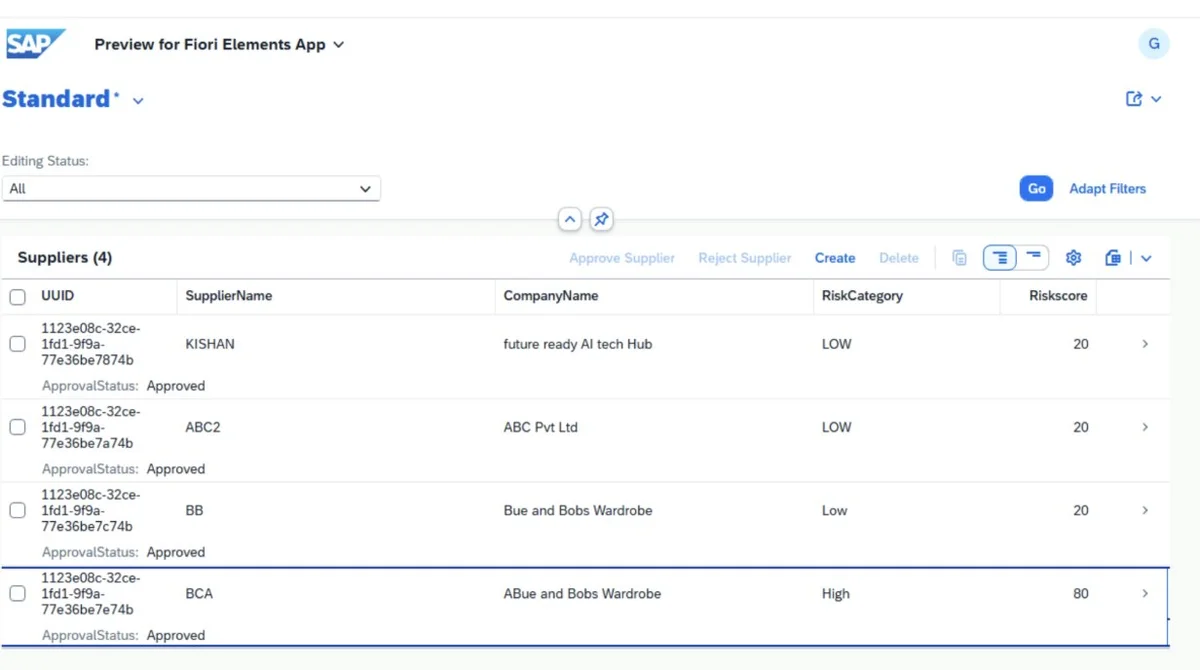
The Supplier Risk Review demonstration shows a RAP business object, a Fiori elements app and an API working together, with a business rule that no consumer can bypass.

Explore Solutions
SAP Fiori list report showing suppliers with a risk category and approval status for each
Demonstration: supplier risk application built with SAP RAP and Fiori elements, running on demonstration data.

Start with the problem, not the product list

Describe the process that is not working and the SAP landscape it runs on. We will tell you how we would approach it and what we would need to assess first.