Reusable answers to recurring enterprise questions
Some problems appear in engagement after engagement. We are turning the patterns we build repeatedly into solution designs that can be adapted to a client's SAP landscape. Each solution below carries a label showing its current status.
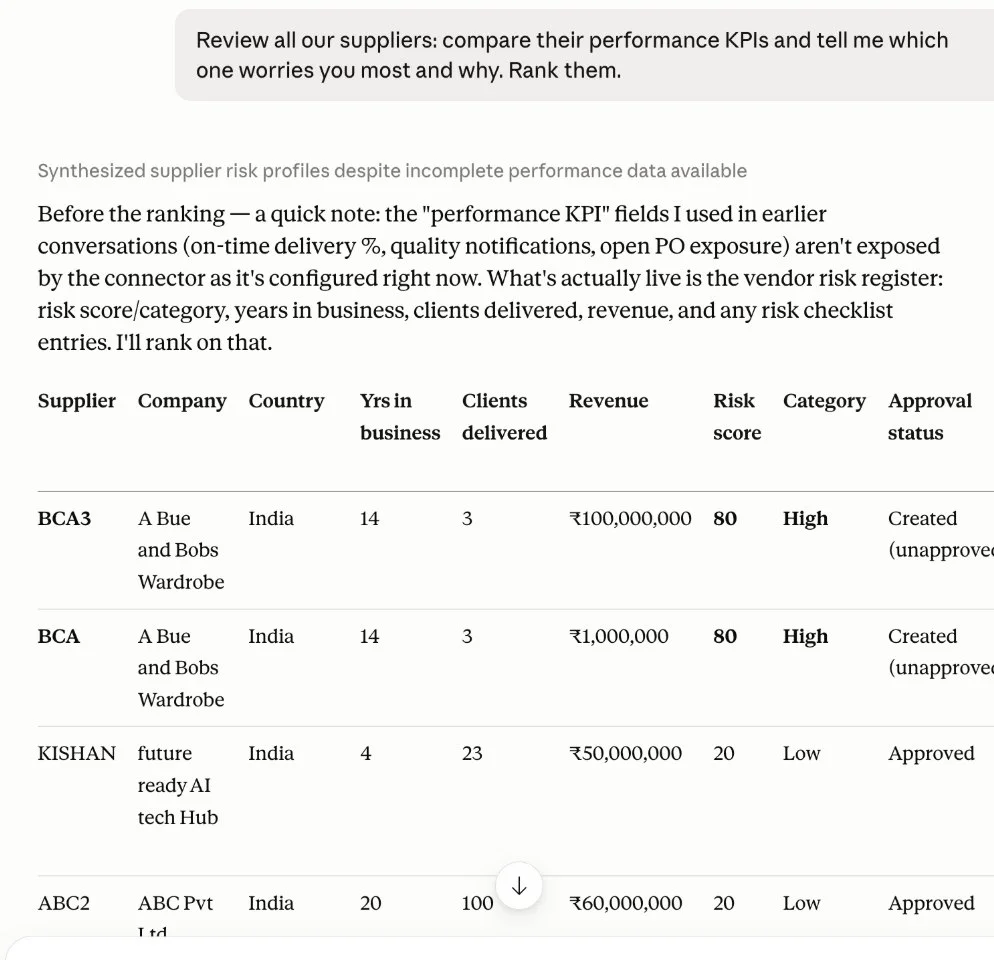
Supplier Risk Review
Procurement and compliance teams often assess suppliers from spreadsheets, emails and separate screens. Reviews take time, and an approval can go through while a serious check is still open.
- Business question
- Which suppliers need attention before the next approval, and why?
- Data inputs
- Supplier master records, open risk checks with their severity, the resulting risk score and category, and the approval status held in SAP.
- Proposed workflow
- Risk checks are recorded against each supplier in an SAP application, and a score is derived from the open checks. Reviewers work from a Fiori list and detail page. They can ask an AI assistant to compare suppliers, rank them and explain what is driving each score, using data retrieved from SAP through a governed interface.
- Human decision points
- A reviewer approves or rejects each supplier. The SAP business object refuses approval while a critical check is open, whether the request comes from the Fiori app, an API or the assistant. The assistant proposes; the business object and the reviewer decide.
- Intended outcomes
- Shorter review preparation, consistent scoring across reviewers and a recorded trail for each decision. These are design goals and have not yet been measured in a client environment.
- Built with
- An SAP RAP business object on ABAP Cloud, Fiori elements, an OData V4 API, a Python service, and Claude connected through the Model Context Protocol (MCP).
Delivery Delay Mitigation
Customer service and supply chain teams usually learn that an order is late when the date has already passed. By then the options are limited to apologising and expediting.
- Business question
- Which open orders are likely to arrive late, and what can be done now?
- Data inputs
- Open orders and order confirmations, delivery and supplier history, and related invoice and payment context from SAP.
- Proposed workflow
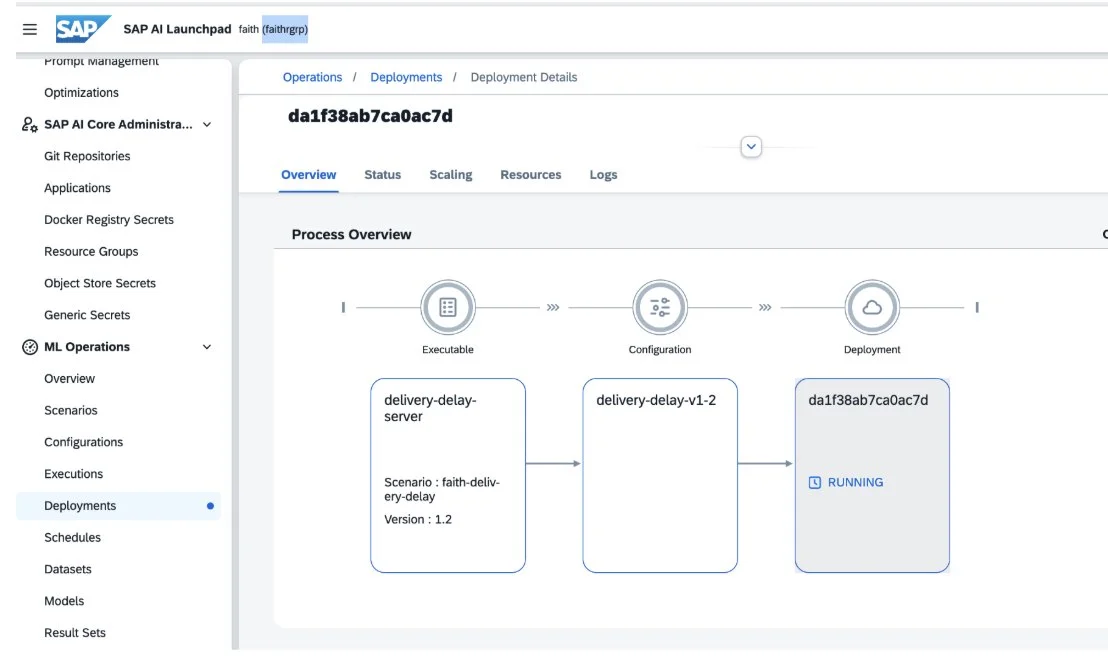
- A prediction service trained on historical deliveries estimates the delay risk for each open order. Planners see the orders at risk, ask an assistant to explain the main drivers and compare similar orders, and review suggested mitigation options.
- Human decision points
- Planners decide which mitigation to apply, such as re-sourcing, re-prioritising or informing the customer. No order, delivery or customer commitment is changed automatically.
- Intended outcomes
- Earlier visibility of orders at risk and fewer last-minute escalations. Prediction quality depends on each client's data and must be validated before any operational use.
- Built with
- A machine learning model served on SAP AI Core and managed in SAP AI Launchpad, Python services, and Claude connected to SAP order data through MCP.
How we label solution status
A label describes the evidence that exists today, so you know what you are looking at. Both solutions on this page are currently demonstrations.
- Demonstration
- Works end to end on demonstration data in our own environment.
- Prototype
- Adapted to a client's process and data model for evaluation.
- Pilot
- Running with a limited group of real users and data, with results being measured.
- Deployed solution
- In productive use, with outcomes that can be evidenced.
From repeatable delivery to FAITH-owned solutions
Our longer-term direction is to develop FAITH-owned intellectual property from work we deliver repeatedly. Today that takes the form of reusable designs, code assets and accelerators that shorten a client engagement.
This is an evolving capability. The solutions on this page are not yet offered as packaged, commercially licensed products, and we will say so clearly when that changes.
See how we connect SAP data to AI-assisted workflowsHave a similar question in your own landscape?
Tell us the decision your team needs to make and the systems the data lives in. We will discuss whether one of these designs is a useful starting point.